Friday, February 17, 2017

Snow collaspes roof in Montreal’s Mile End


Apparently the building is the former Stuart Factory where May West and Jos Louis cakes were once manufactured.

16807157_1147835508660832_6309384342793862762_n

Snow-laden roof collapses in Montreal's Mile End

Published on: February 17, 2017 | Last Updated: February 17, 2017 6:53 AM EST

Traffic at Laurier and de l’Esplanade Aves. may be a little more difficult than usual Friday morning after the roof of a vacant commercial building at the site caved in, apparently because of an overload of snow.

16830693_1147831735327876_1903566966271527019_n

- courtesy Martin Wohlgemuth


©2017 The Past Whispers
All Rights Reserved

Thursday, February 16, 2017

East End Kids Documentary


Carole Laganière films the hopes, the fears and the dreams of kids living in the deprived Montreal neighbourhood where she grew up.

East End Kids


©2017 Linda  Sullivan – Simpson
The Past Whispers
All Rights Reserved

Monday, February 13, 2017

A New England Mardi Gras – The International Snowshoe Convention of 1925–by James Myall


25288

“Fun for all, and all for fun,” was the verdict of one local newspaper; “a Mardi Gras” reminiscent of the pre-prohibition era, according to another. On the weekend of 7-8 February, 1925, eight hundred French Canadian snowshoers descended on the city of Lewiston, Maine (population 30,000), for two days of revelry and winter sports. The festivities…more


©2017 Linda Sullivan – Simpson
The Past Whispers
All Rights Reserved

Friday, February 10, 2017

Church of the Madonna della Difesa


1280px-Eglise_Notre_Dame_Defense_Mtl

The Church of the Madonna della Difesa is a Catholic church in the neighbourhood of Little Italy in Montreal, Quebec, Canada. It was built by Italian immigrants to the city, specifically those from Molise, to commemorate the apparition of the Madonna in La Difesa, in Casacalenda, Molise. It was designed by Roch Montbriant and Canadian artist Guido Nincheri. It is Romanesque in style and laid out in a Greek-cross floorplan. It was inaugurated in 1919.

It is famous for its large cupola and brick façade, and especially its frescos by Guido Nincheri. A particularly well-known fresco depicts Benito Mussolini; painted before World War II, it commemorates his signing of the Lateran Accords. A statue in front of the church commemorates "victims of all wars."

Designated a National Historic Site of Canada in 2002, it is located at 6800 Henri-Julien Avenue at the corner of Dante Street (Jean-Talon or Beaubien metro stations) in the borough of Rosemont—La Petite-Patrie. Plaqued in 2005, the Church serves the oldest Italian community in Canada.

Three priests serve at the church, Padre Luca Brancolini, Padre Giuseppe Manzini and Padre Jacques Duplouy; all are members of the Priestly Fraternity of the Missionaries of St.Charles Borromeo.

©2017 Linda Sullivan – Simpson
The Past Whispers
All Rights Reserved

Tuesday, February 7, 2017

St. George’s Anglican Church – Montreal


800px-St_George_Anglican_Montreal

The original St. George's Church opened on June 30, 1843, and was on Notre-Dame Street (then Saint Joseph Street) and Saint David's Lane, just outside the city of Montreal's walls. It was the second Anglican congregation in Montreal and was built to accommodate the overflow of parishioners from Christ Church Cathedral. An organ built by Samuel Russell Warren was installed later that year.

The congregation of St. George's continued to grow as the city expanded to the west. A plot of land at the corner of Peel Street and De la Gauchetière Street was chosen as the site of the current church. This piece of land had been a Jewish cemetery from 1775 to 1854. St. George's was designed by Montreal architect William Tutin Thomas, constructed in 1869, and opened its doors on October 9, 1870. The only furnishing retained from the old church was the pulpit. The old church would serve as a factory for organ-maker Samuel Russell Warren.

The parishioners of St. Jude Church (corner of Coursol Street and Vinet Street in Little Burgundy) and Church of the Advent (corner De Maisonneuve Boulevard and Wood Avenue in Westmount) joined those of St. George's following their churches' closures.

Designated a National Historic site in Canada in 1990.


©2017 Linda Sullivan – Simpson
The Past Whispers
All Rights Reserved

Monday, February 6, 2017

Mile End – Saint Louis


The second growth spurt of Mile End coincided with the introduction of electric tramway service in 1893; the area can be considered an example of a streetcar suburb. The agricultural and industrial exhibition grounds at the southwest of the village, near Mount Royal, were subdivided in 1899 for housing. The village became a town in 1895 and changed its name to simply Saint-Louis. Apart from a tiny street located just outside the town's northwestern limit, and (for its remaining years) the railway station, the name Mile End passed out of the official toponymy for close to a century, coming back into use as a municipal electoral district only in 1982.

The town of Saint-Louis built in 1905 a magnificent town hall on the northwest corner of Saint-Laurent and what is now Laurier Avenue; the building still serves as a fire hall and firefighters' museum. The town was annexed by the expanding city of Montreal on 29 May 1909, taking effect as of 1 January 1910, and became Laurier Ward (quartier Laurier). Population growth had been explosive: in 1891, the village had 3537 residents; in 1911, after annexation, the ward's population was about 37,000.
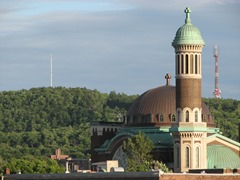
Eglise_St_Michael

Perhaps the most recognizable architectural symbol of Mile End is the Church of St. Michael the Archangel of 1914-5, on Saint-Viateur Street at the corner of Saint-Urbain. The church, designed by Aristide Beaugrand-Champagne, was built for an Irish Catholic community, as expressed by omnipresent shamrock motifs; yet the overall style of the building is based on Byzantine rather than Western architectural traditions. Even more striking, the church has a slender tower that resembles a minaret. The building has been shared since 1964 with the Polish Catholic mission of St. Anthony of Padua, which officially merged with the parish of St. Michael in 1969 to form the current parish of St. Michael's and St. Anthony's; masses are celebrated in Polish and in English.


©2017 Linda Sullivan – Simpson
The Past Whispers
All Rights Reserved

Friday, February 3, 2017

Mile End – The Coming of the Railway


Mile_End_Station_Montreal
Mile End Station – Montreal

The transcontinental railway gave Mile End its first growth spurt and separate identity. In 1876, the Quebec, Montreal, Ottawa and Occidental Railway – a project vigorously promoted by Antoine Labelle and Louis Beaubien – came slicing through the area on its way from east-end Montreal to Sainte-Thérèse, Lachute, and Ottawa. This railway was bought in 1882 by the Canadian Pacific, and it was by this route that the first trains departed for the Prairies in 1885 and for Port Moody, British Columbia in June 1886 (extending to Vancouver in 1887). The first Mile End station building was erected in 1878 on the east side of Saint-Laurent Road, near what is now the intersection of Bernard Street. (A much larger station was built in 1911; it closed in 1931, when service was moved to the new Park Avenue Station (Jean-Talon), and was demolished in 1970 to make way for the Rosemont–Van Horne viaduct.)

Also in 1878, the village of Saint-Louis-du-Mile-End was incorporated, population 1319. Its territory consisted of the western third of Côte Saint-Louis: bounded on the west by the limit of Outremont (generally along Hutchison Street), on the south by what is now Mont-Royal Avenue, and on the east by a line running mostly just east of the current Henri-Julien Avenue. The northern border was north of present-day De Castelnau Street or just south of Jarry Park.

- Wikipedia

(2017) Linda Sullivan – Simpson
The Past Whispers
All Rights Reserved